CATCHMENTS 2025 BLOG #3 LOUGH MUCKNO
We became interested in County Monaghan’s largest lake because we wanted finally to focus a chapter of our exploration of Ireland’s freshwater bodies on the all important question of water quality. We discovered that this lake, which supplies drinking water to Dundalk town, has been under scrutiny since 2007 and has consistently been flagging as ‘bad’ or ‘moderate’ under the Europe’s overarching Water Frameworks Directive. And yet the lake appears to be a haven of biodiversity. Can such a waterbody supply water good enough to drink? Is the apparent health of the eco-system an illusion? We needed to find out…
BLACK AND WHITE
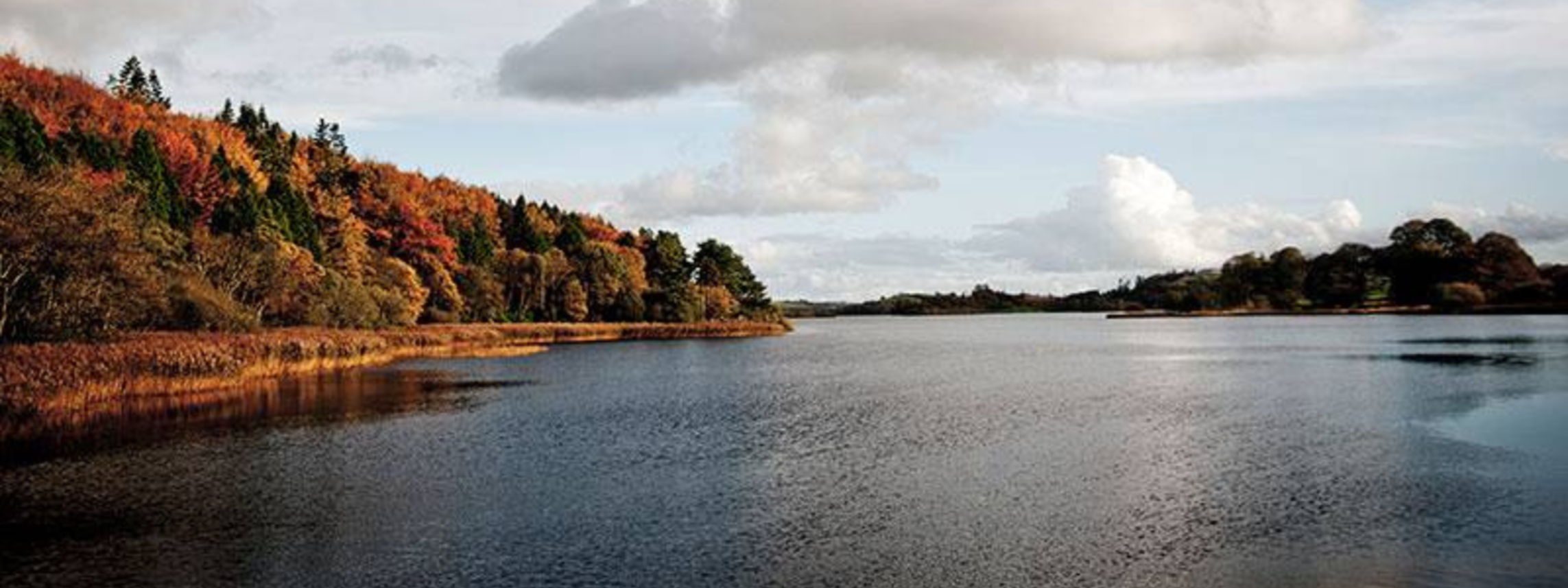
We did our first recce of the lake in February in the company of Dr. Patricia MacCreesh, Biodiversity Officer at Monaghan County Council, and Liam Murtagh, a founding and very active member of Friends of Lough Muckno, a community group based in Castleblayney on the western shore of the lake. The town has always had a close relation with the lake since its foundation in the 17th Century. After a tumultuous first half-century in Ulster, starting with the Nine Years War and the Flight of the Earls and ending with rebellion and Cromwellian reconquest, the British Crown confiscated the lands of the MacMahons and granted them to army officer Baron Blayney. Blayney Castle (later supplanted by the now derelict Hope Castle) was built on the western shore of the lake at the top of a drumlin, looking eastwards over two islands that became known as Black Island and White Island. Both are now joined to the land, the first by a bridge and the second by a causeway. The first is a densely forested drumlin and the second is parkland with trees and meadow surrounded by riparian vegetation. Storm Éowyn felled great numbers of trees on Black Island, but White Island was relatively spared, perhaps because it isn’t afforested with conifers. Beyond there are several smaller islands with naturally regenerating vegetation - nested by cormorants who provide much of what makes the island soil so rich - as the lake stretches three miles eastward, between the drumlins to the waterworks at the Clarebane River on the upper reaches of the River Fane.
MESOTROPHIC TO EUTROPHIC
In May we meet at the lakeside with Suzanne Linnane from Dundalk Institute of Technology. Mary Kelly Quinn, Professor of Biology at UCD, had recommended her old student Suzanne as someone who could talk to us about the lake’s water quality. Suzanne gives us a brief and clear introduction to the issues of water quality in Lough Muckno. Her interest in Lough Muckno goes beyond the professional: Suzanne lives at Blackrock in County Louth, a neighbourhood which, like most of the greater Dundalk area, gets its drinking water from Lough Muckno. There have been problems: the high levels of phosphates in the lake water stimulates growth of algae and other potentially dangerous microorganisms. This has the knock-on effect of increasing the volume of chemicals put into the water in subsequent treatment. There is then a risk of higher levels of trihalomethanes (THMs), a by-product of chlorination of water that can potentially be carcinogenic. “We need to marry the elements of Lough Muckno that are so important,” Suzanne says, “Heritage, biodiversity and economy. We need to protect what we already have - it’s such an important site for so many species of flora and fauna - but also we need to look after the economy in a sustainable way. If we have tourism, if we have eco-initiatives, we need to do them sustainably and in keeping with our biodiversity and our heritage”.
There has been a long period of public reflection at a local level, much of which has fed into the preparation of a 10 Year Master Plan for Lough Muckno and its environs by Monaghan County Council after a long period of public consultation. Liam Murtagh familiarizes us with this and with reports, articles and Youtube videos on the lake's problems and strategies to restore it (including a plan to turn it into an adventure park). We discover that, for over a decade, Lough Muckno has been considered one of Ireland’s ten most polluted lakes. Phosphates from agricultural land, a municipal wastewater treatment plant, domestic septic tanks and forestry have caused nutrient enrichment. Under the European Union’s Water Framework Directive (WFD), the lake has been classified as mesotrophic or eutrophic: higher-than-ideal nutrient levels that support excessive algae growth, ranging from fairly high to unsustainably high. Liam told us that in the past decade there has been some algal bloom almost every year during the summer months. Monaghan may be south of the border but it is in Ulster, and everyone is aware of the catastrophic algal bloom that hit Lough Neagh in 2023 and that seems set to continue.
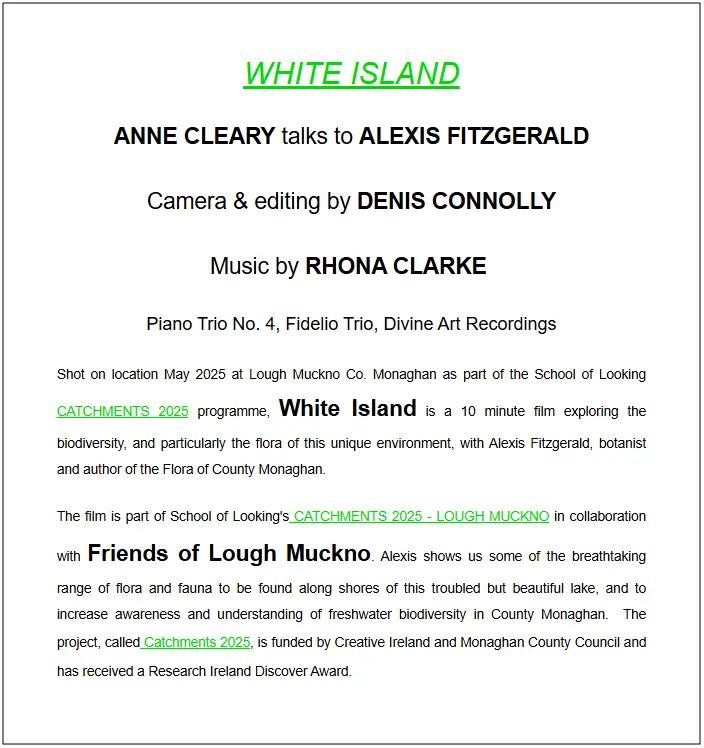
WHITE ISLAND
In early May we walk out from Hope Castle to White Island with botanist Alexis Fitzgerald looking at the biodiversity and particularly at the remarkably rich flora on the shores of the lake. Alexis is the author of Flora of County Monaghan, a compendium of the unique plant life in this county of lakes and drumlins (with soil that looks brown and rich despite Patrick Kavanagh’s insistence on stony greyness). White Island seemed like a good place to start exploring the remarkably beautiful biodiversity of this problematic lake and its environs.
Alexis speaks knowledgeably and lovingly as he bends down to show us tiny wild flowers - Herb Robert, Birdsfoot Trefoil, Vetch, Loosestrife… He points out the “living fossil” Water Horsetail, the discrete little survivor of the ancient Equisetidae which dominated carboniferous forests for millions of years, some growing to the size of trees. He points out the large masses of nettles and cow parsley along the edge of the lake - both thrive in nutrient rich soil and are indicators of phosphate pollution. He shows us leaves and flowers we can eat (but beware of dog pee), some with medicinal properties like Meadowsweet and Yarrow.
Alexis is most poetic when he shows us the trees. Horse Chestnut is in bloom and Anne and I are ashamed to admit that this is the first time we have looked closely at the exuberant sculptural beauty and painterly colours of the flower on this noble (if not native) tree, more famous for the prickly nut that will replace the flowers later in the year.
A little further along our walk, we wade into the long marsh grasses to look at a willow tree growing out of the water at the lake's edge. Alexis talks about all the life supported by a mature willow tree, in particular the beautiful filigree of lichens covering its branches. He explains that this too is an ancient lifeform, one of the first to emerge from the sea, a symbiotic alliance of algae, fungus and bacteria using the tree only for support, collecting energy from the sun and moisture from the air. Looking at a magnified image of the lichen, we marvel at the beautiful variety of verdigris tectonic forms - a little metropolis.

THE LONELY BUSH
We approach a Whitethorn, a small tree that often stands alone, even referred to as the lonely bush. It, too, was in bloom: beautiful frothy white flowers, many still tiny bulbs, above the dark thorns - in the month of May you can see them everywhere sprinkled across the drumlins of Monaghan. Alexis explains that this was long considered a fairy bush - not a good thing in Ireland, rather an object of superstition, an evil to be avoided - the reason why farmers leave Whitethorn bushes growing in their fields and plough around them. Fairies have a strong bond with the trees - they have been heard mourning when a Whitethorn is cut down and bad things can happen to anyone doing violence to the tree. There is the case of the so-called Latoon Bush in County Clare, earmarked for destruction to make way for a motorway in 1999. A famous storyteller and fairy expert Eddie Lenihan warned that cutting down the tree would put in danger any motorists driving over the spot as the tree was in the path of Kerry Fairies going to do battle with Connaught fairies. The engineers may have scoffed, but in the end they preserved the tree.
MUCKNO MANIA
We return again to Castleblayney in early July, this time to launch White Island, the film we made with Alexis Fitzgerald in May, and to run a series of biodiversity and art workshops coinciding with the local summer festival, Muckno Mania. Many people we meet are concerned about the lake. There is frustration at the lack of awareness in the wider community about the issue of water quality and what can be done to address it. Monaghan County Council have just released a report on the water quality. Liam presents it before the premiere of White Island at Íontas Theatre on Friday evening. It makes grim reading - at least 12 years for the lake to recover, even after full implementation of phosphorus reduction strategies. An impossible task in the context of the EU WFD requirement that Ireland's lakes and rivers reach good ecological status by 2027. Much is said, and it is at least an hour before we can finally show the short film of our magical walk on White Island with Alexis in May, a bitter-sweet ending to a sobering evening, and a reminder of what we stand to lose if we don’t learn to care for the resources that the earth provides us.
On Saturday we set up headquarters at Castleblayney Library in the gatehouse of the Blayney demesne, recently extended into a very pleasant modern facility - and our warmest thanks to Audrey Wilson, Creative Communities Engagement Officer at Monaghan County Council for setting us up there. Our programme for the weekend includes walks, quadrat surveys, FIT counts, film and photography, drawing and print making for a wide local public. We invite Dervla McElvaney - a local artist with a background in textiles and floristry - to do a workshop with plant-based dyes, exploring how natural colour is used in textile art, and experimenting with mark-making and creative techniques using a range of natural colours.

Children’s writer Fiona Longmuir - who had already been working with us and with a group of local children on a creative writing programme based on the lake’s history and biodiversity - presents what they have written on Saturday morning, each child reading their work and Fiona herself reading a short piece she has written that centres on a Hawthorn tree - the fairy bush! Fiona tells us afterwards that she got married under a Hawthorn, so Irish superstition clearly doesn’t extend to her native Scotland.
On Saturday and Sunday we set out on three programmed nature walks, retracing our steps with Alexis in the company of three different local groups. Assisted by Helena Brady, the project’s resident botanist, we walk to White Island in the company of local people of all ages and survey the biodiversity in the meadow at the centre of the island using a quadrat. Together we look at ladybirds, butterflies, and pollinators. We draw wildflower in our notebooks. Helena and Anne (who has become remarkably knowledgeable) help identify insects, birds, flowers, grasses and trees. We put up a drone to observe the island and lake from the air; we used macrophotography to view plants and insects more closely; we record birdsong with a shotgun microphone… and all the way there and back the group chats about the perils faced by this haven of biodiversity, but also the promises it holds.


Written by: Denis Connolly, 2025
Image: Monaghan Tourism