
Innovating with Nature: Factors Influencing the Success of Nature-Based Enterprises
By McQuaid, S.; Kooijman, E.D.; Rhodes, M.L.; Cannon, S. Innovating with Nature: Factors influencing the success of Nature-Based Enterprises. Sustainability 2021, 13, 12488. https://doi.org/10.3390/su132212488
Short summary:
The capacity of nature-based solutions to create economic opportunities and green jobs is well cited in the literature, yet there is a dearth of empirical literature showing evidence of these economic benefits or green jobs or how they might be achieved. Nature-based enterprises (NBEs) have recently emerged as important actors in the delivery of nature-based solutions (NbS) to societal challenges. However, little is known about the context – the external environment - in which they operate and the factors influencing their development. The paper by McQuaid et al. (2021) provides further insights into the external factors influencing NBE through a review of literature related to sustainability-oriented enterprises, an enterprise survey, and interviews with NBE.
Given the sustainability orientation of nature-based enterprises and the close interlinkage with nature-based solutions, literature on factors influencing sustainability-oriented enterprises and the implementation of NbS was reviewed. For this review and the enterprise survey (182 respondents, 148 included) and interviews with the founders/CEOs of NBEs (22), the factors were categorized using ‘PESTEL’. The ‘PESTEL’ (i.e., political, economic, social, technological, environmental, legal) framework is a widely accepted framework for analysing external factors affecting firms in the business strategy literature. The findings are summarized in Figure 1 below.
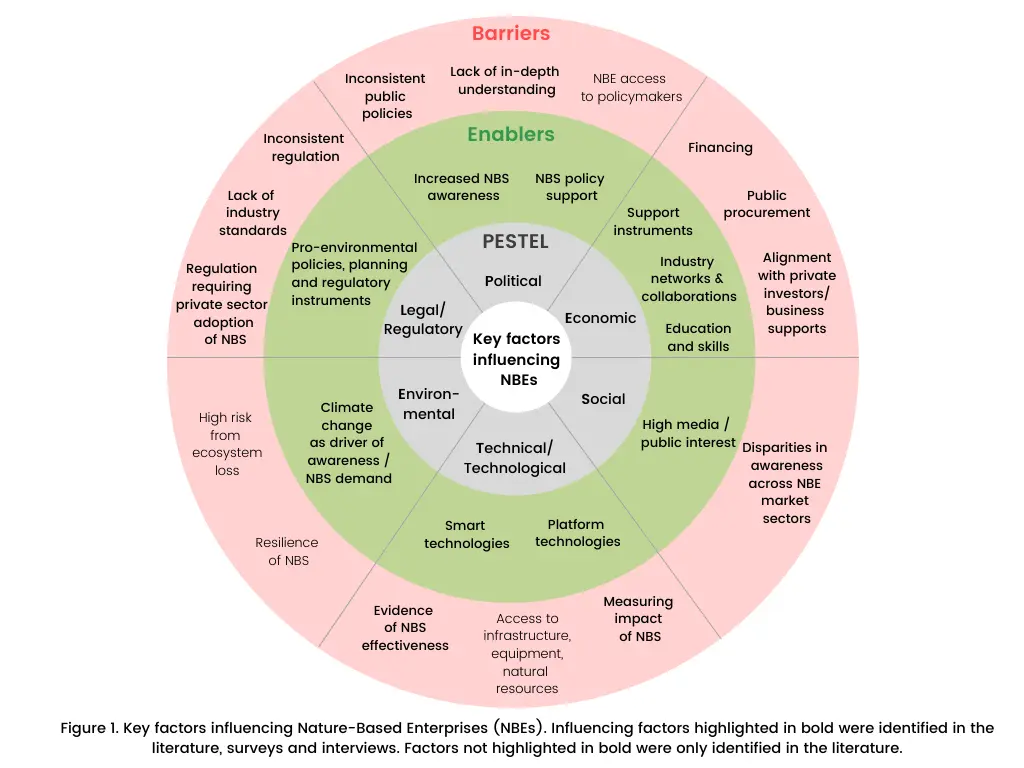
Nature-based enterprises identify political and regulatory factors (awareness of NBS levels among policy makers, policies and regulations enabling/limiting NBS uptake) as the most significant external factors influencing demand for NBS. Policy inconsistencies and poorly designed public procurement approaches present significant challenges, as well as silo gaps.
“You have the planning authority, who does this work here, we have the environment authorities, you have another authority, which is focusing on tourism, which does some environmental work, you have transport, which is a key player and you have experts who are all in these fields, who are doing similar things, sometimes even competing with each other, and we’re trying to bring these people together, but their priorities are different”. (I16, p.9)
Economic factors (factors influencing market development, financing, and investment in NbS/NBEs, industry development) were also found to be highly influential. Economic instruments such as subsidies or fees were found to have an important positive impact on market development and private sector investment in NbS. Lack of financing for NbS was a major barrier identified in both primary research and literature. From a socio-economic perspective, important influencing factors on NBE development identified across literature and primary research included increased levels of public awareness of environmental issues and the availability of education, skill and training for NBEs. Industry networking and access to education, training, and skill development emerged as key enablers, with university collaborations highly regarded.
“What’s really enabling has just been the public’s understanding of the environment. So our members, they’re all super hungry to learn more about you know, mitigating climate change, rewilding nature, restoration”. (I9)
Regarding technical/technology barriers, lack of evidence of the effectiveness of NbS remains a major stumbling block which is compounded by a lack of knowledge on how to measure the multiple impacts of NbS.
“We were winning awards for biodiversity, for instance, for our building. . . But to be honest, we don’t know whether this is good for biodiversity. . . because we’ve had no formal research done”. (I5, p.11)
The findings of this study show that politicians and policy makers at the national and local government levels can play a pivotal role in addressing many of the barriers identified by nature-based enterprises, from addressing knowledge gaps and inconsistencies in public sector approaches, to putting in place the policy instruments to stimulate NbS market demand and private sector investment. Further in-depth research is recommended to explore indications of disparities in the levels of awareness, financing, and skills gaps across different regions of Europe and different nature-based economic activities.