Investing in Nature, People & Livelihoods: Webinar Recording & Key Takeaways
CNEP’s latest webinar with Ciarán Fallon of The Nature Trust in Ireland and Alan McDonnell of Scotland based Trees for Life. Both organisations are involved in large scale ecosystem restoration and regenerative forestry projects - front and centre of much of the current debate around the Nature Restoration Law.
You can find the unedited full webinar recording and the key insights and takeaways below.
Following short presentations from each of the speakers, lively discussion followed on some of the opportunities and challenges in scaling these nature-based solutions in Scotland, Ireland and across Europe. We have summarised some of the key insights from the session below as well as links to both organisations websites and some of the resources and other companies mentioned. That said, we highly recommend listening to the full recording above.
Key Insights & Takeaways
1. Opportunities for Nature-Based Enterprises
Regenerative forestry, rewilding and ecosystem restoration have an abundance of opportunities right now for nature-based enterprises working with integrity to deliver for nature, for community and for the local economy. Opportunity exists in the actual delivery and implementation of projects and there is a real gap in the market for organisations providing measurement & metrics services, particularly in measuring ecological uplift and biodiversity.
“In my mind there is a really bright future in this area. I’m looking at the West of Ireland and peatland restoration projects we’re involved with - we need skilled contractors who are used to working on peatlands and can carry out that work using the latest techniques.” (Ciarán Fallon, MD, The Nature Trust)
2. Financing & Investment
Financial constraint is not the barrier that it was ten and twenty years ago in these sectors. Access to land & the availability of skilled contractors is negatively affecting the ability to scale nature-based solutions in this space.
“Finance is not the issue any more. We are project & capacity constrained. It's ‘can we get the land’ and ‘can we find the contractors and people with the skills on the ground to deliver them’.” (Ciarán Fallon, MD, The Nature Trust)
3. Workforce Supply & Education
The lack of professionals coming through our education systems for forestry and ecological recovery is a barrier to scaling NbS today. Potential solutions include upskilling mid-career professionals changing over to this very rewarding sector where salaries may not be such a deterrent for this cohort. Private sector education, skills and training provision is another solution to addressing this gap.
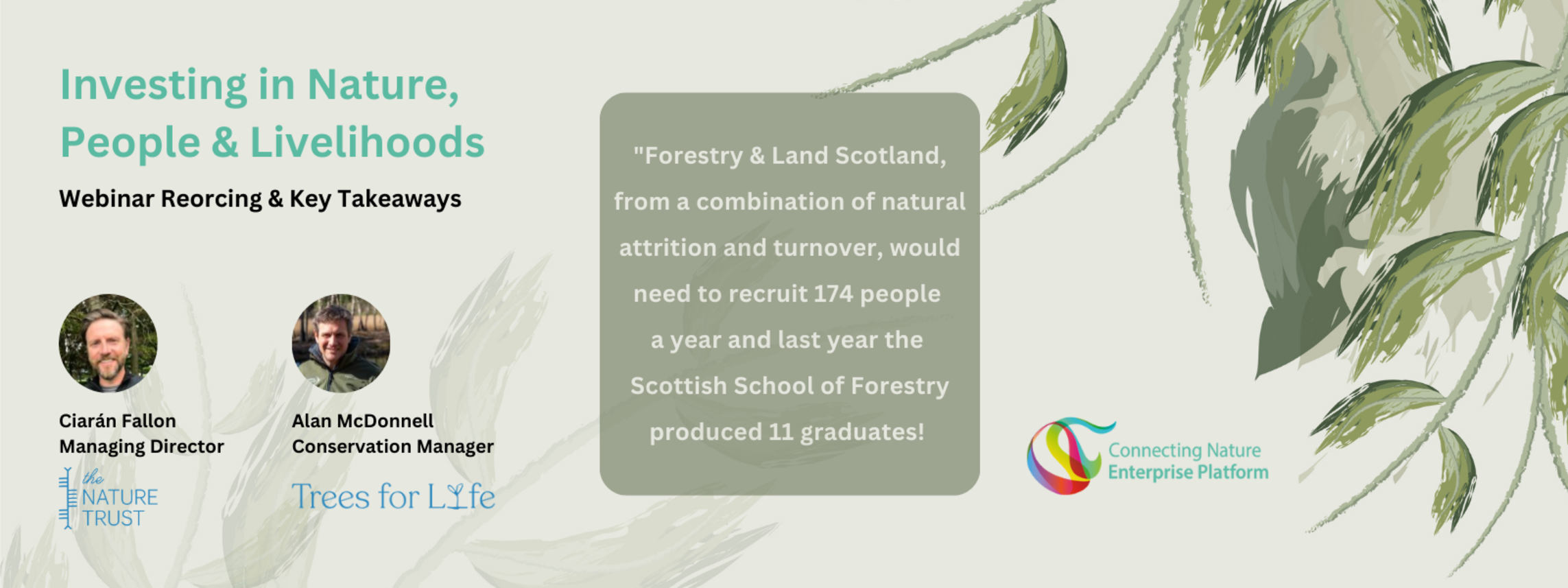
"Forestry & Land Scotland, from a combination of natural attrition and turnover, would need to recruit 174 people a year and last year the Scottish School of Forestry produced 11 graduates!
Of course, they are not the sole source of forestry graduates but they are one of the main providers of bespoke forestry training. They do have quite a nature element to their forestry programme now…but what we need is a combination of 'outlook' - with people looking for a more nature-based approach, as here our vocational education system is still quite focused on conventional forestry and conventional farming and so that feels a little behind.
We need to complement that with more specific skills and training which could come from the private sector and entrepreneurs looking at different approaches, perhaps working with some of the cultural organisations that are out there.
For instance, in Scotland we have The Association of Scottish Hardwood Sawmillers who can provide training in working with hardwood forestry and producing commercial products in a sustainable way from a native woodland or a mixed woodland. I think those practical skills and similar are the biggest gap."
(Alan McDonnell, Programme Development Manager, Trees for Life)
Conversation Continued with Ciarán adding…
"The challenge that you (Alan) described in Scotland is identical in Ireland. We have very small numbers coming through and we need to be recruiting. We are hiring young foresters from all over the world now so there is a shortage of homegrown foresters.
One of the things we need to look at as well is mid-career people who want to convert and come into forestry and maybe come with other skills - legal, finance, project management skills and so on. There is a real role for conversion courses & masters.
The sector is offering really fulfilling roles and a lot of people I meet are driven by this - the possibility to work in a space where you can feel like you are making a difference. It's a tremendous motivator."
(Ciarán Fallon, MD, The Nature Trust)
4 . Standards & Integrity
Establishing standards for best practice is key to the success of nature restoration and ensuring a balanced outcome for nature, community and economy alike. There is great potential for land based livelihoods and great possibilities for the local economy and environment exist but we must respect our heritage and connection to the land and engage in open dialogue with all stakeholders.
5. Human Connection to Nature & Each Other
Community engagement is fundamental to making nature recovery work in perpetuity. For 200 years and more, communities have worked the land, often to its benefit but more recently resulting in its degradation. This connection to nature can be restored and encouraged through our education systems and become a catalyst for regeneration, particularly where we tell the story of restoration in an engaging and meaningful way.
In conclusion, this is only a small snapshot of the fantastic insights and practical examples we heard from Ciaran Fallon of the Nature Trust and Alan McDonnell of Trees for Life.
We encourage you to watch the full recording of the webinar available here. Grab yourself a cup of tea, a pen and paper and hear from these industry professionals walking the talk of nature recovery.
Supported by: